Sugama is a 3D adventure game. Your child picks a buddy, wanders through small, cozy villages, helps the villagers and meets playful monsters. To help them, your child solves a sum, and every right answer becomes a spell.
Play first, math is the magic
It is not homework, it is an adventure. Each sum is a spell that opens a gate, clears a path or calms a monster down.
The right level for each child
Math points track Add, Subtract, Multiply and Divide separately, so questions are neither too easy to be boring nor too hard to be discouraging.
Parents can see progress
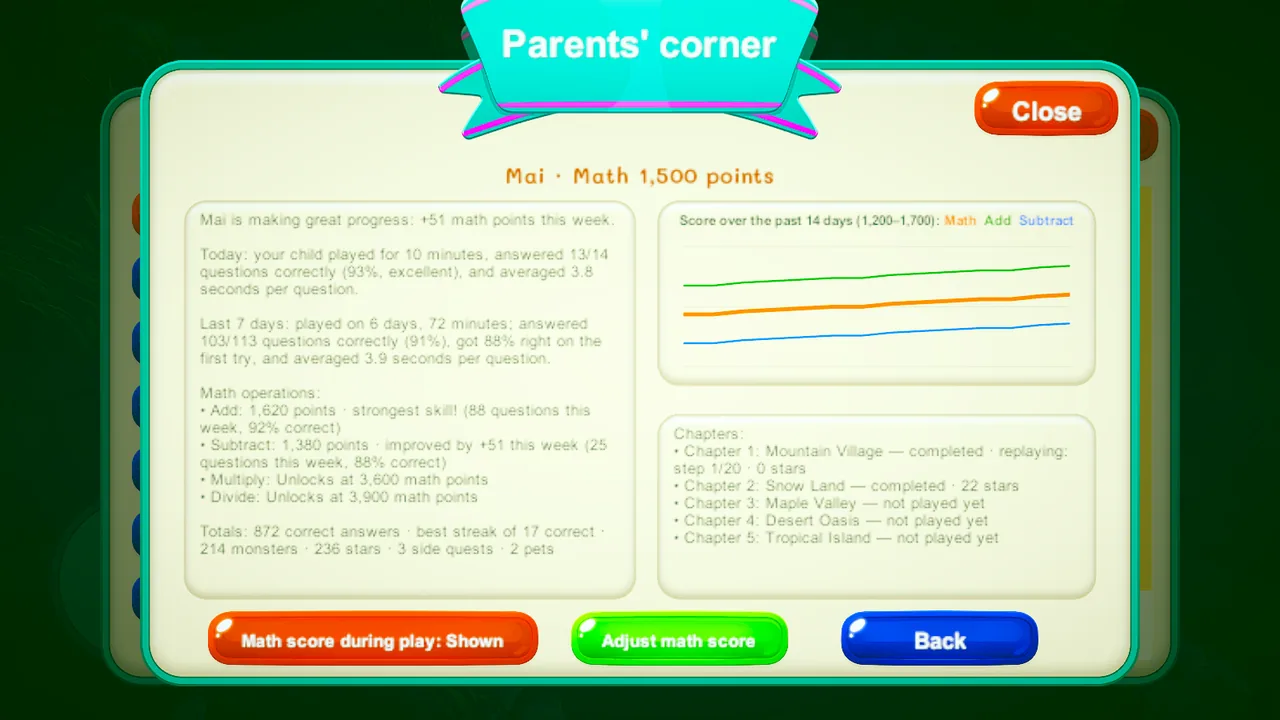
The Parents' corner shows today, the last 7 days and a 14-day chart of math points. Reports praise effort and never grade the child.
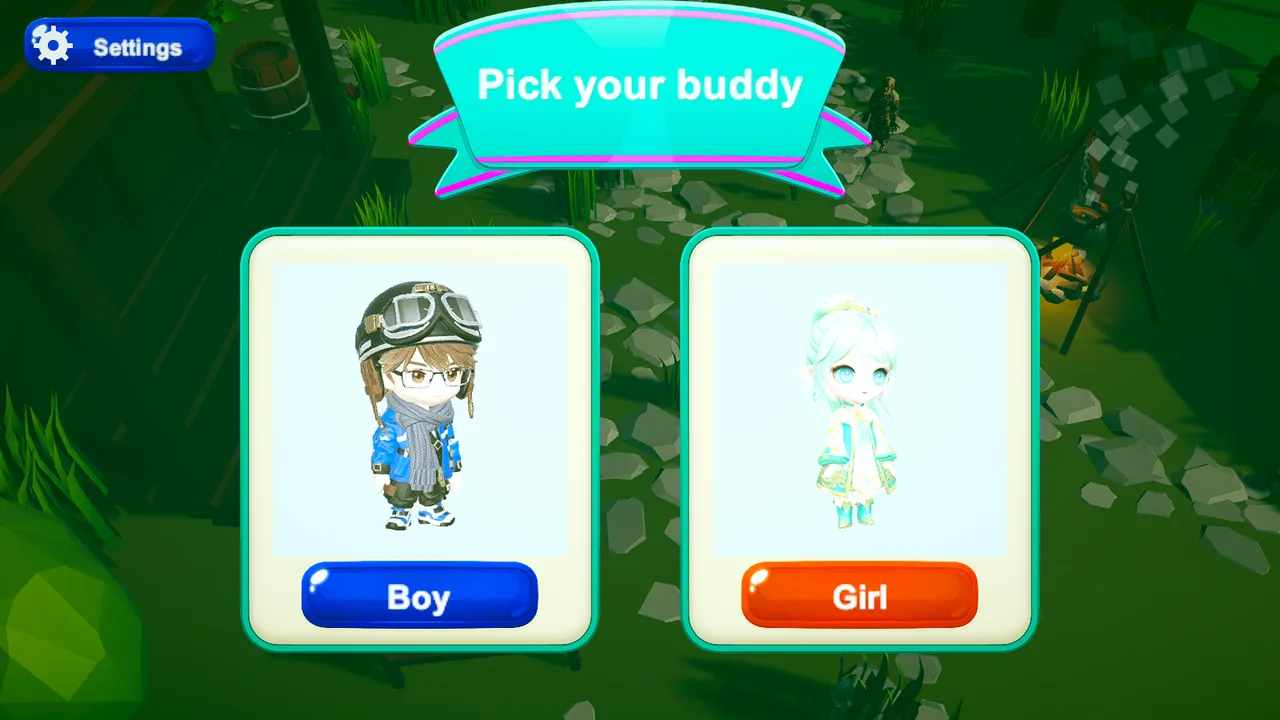
Your child picks a buddy on the start screen.
Range: from adding within 5 to dividing a 4-digit number by a 2-digit number; no number goes above 9,999. The order of question types follows Vietnam's 2018 national math curriculum.
How to play
How does your child play?
Four steps, repeated in every land.
Pick a buddy
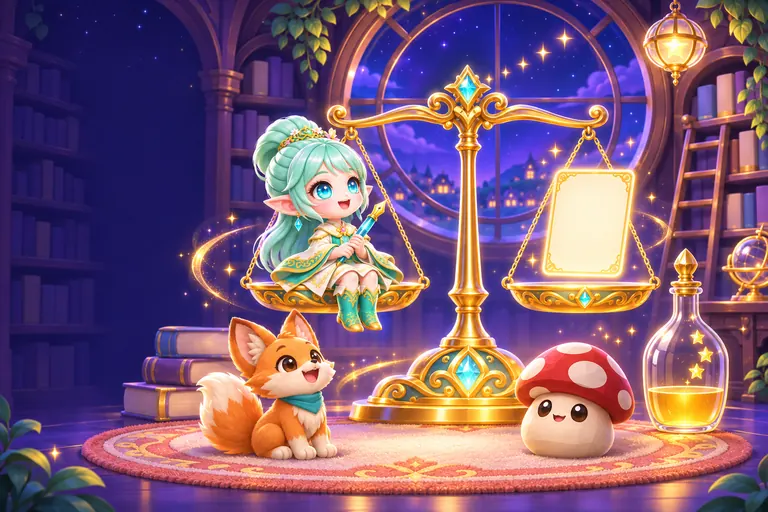
A little aviator with glasses and a scarf, or a mint-haired elf girl with pointed ears and a small tiara.
Follow the golden trail
Walk with the joystick or tap where to go. The glowing trail leads to each quest: talk to villagers, open secret chests, pass through magic gates.
Meet a monster, solve the sum
The sum appears above the monster's head. A right answer casts a spell.
Earn stars, medals and pets
At the end of a chapter your child gets a bronze, silver or gold medal and a new pet that follows along.
There is no game over. Your child just keeps exploring.
What happens in a fight
From afar, a monster only shows a purple question mark. When the fight starts, the sum appears above each monster.
Right: the spell flies to the monster. Not yet: the game says “Try again!” and hints “Count nice and slow!”
The monster walks closer slowly. The time depends on the difficulty: 15 seconds on Seedling, 10 on Sprout, 5 on Leaf. On Automatic: 15 seconds below 2,000 points, 12 below 4,000, then 10. Boss fights allow more time (×1.5). If the monster arrives, it hops back and your child simply keeps answering; nothing is lost.
For a calmer pace, turn on “Gentle mode”: monsters stand still while your child answers. With handwriting, the monster also waits while the writing is being read.
Can't read yet? “Read questions aloud” is on by default: the game reads each sum out loud.
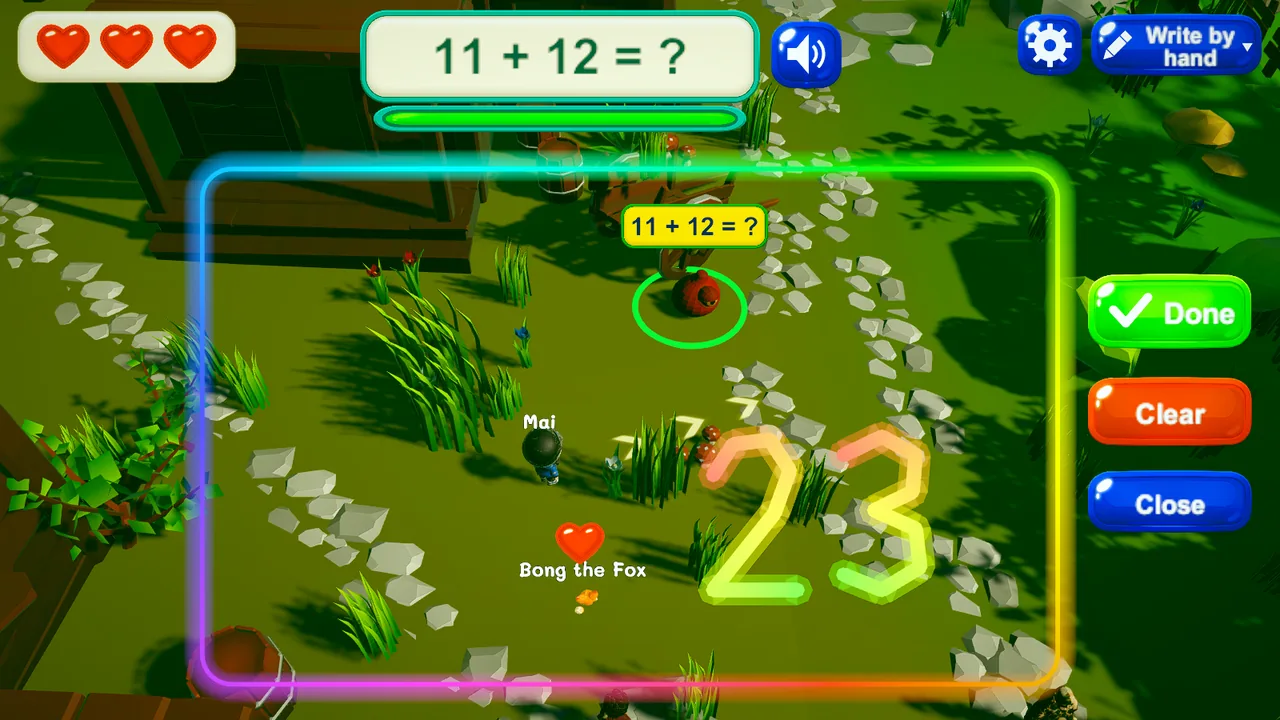
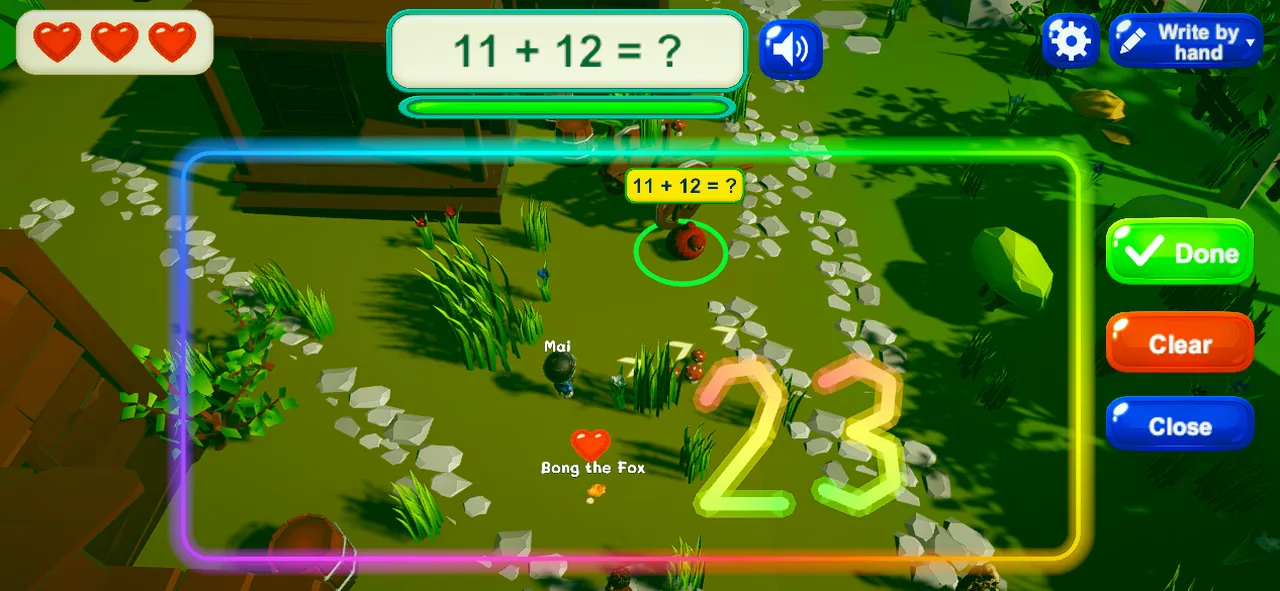
Your child writes the answer with a finger.
Answers
Four ways to answer
Every child is at a different stage. Switch the way of answering during a fight with the button in the corner of the answer panel, or in Settings › How to answer.
Write by hand
Default
Your child writes the number on the board with a finger. After a short pause the device reads it and sends it. The reader runs on the device, without internet; the first time it needs a small download of about 2 MB.
Why handwriting first? A study with preschool children found that practicing handwriting helped the older children in the group recognize letters better than practicing typing (Longcamp et al., 2005). That study was about letters; we apply the same idea to digits.
Number pad
Big, easy-to-press number keys with a delete key. Good for children who already know their digits.
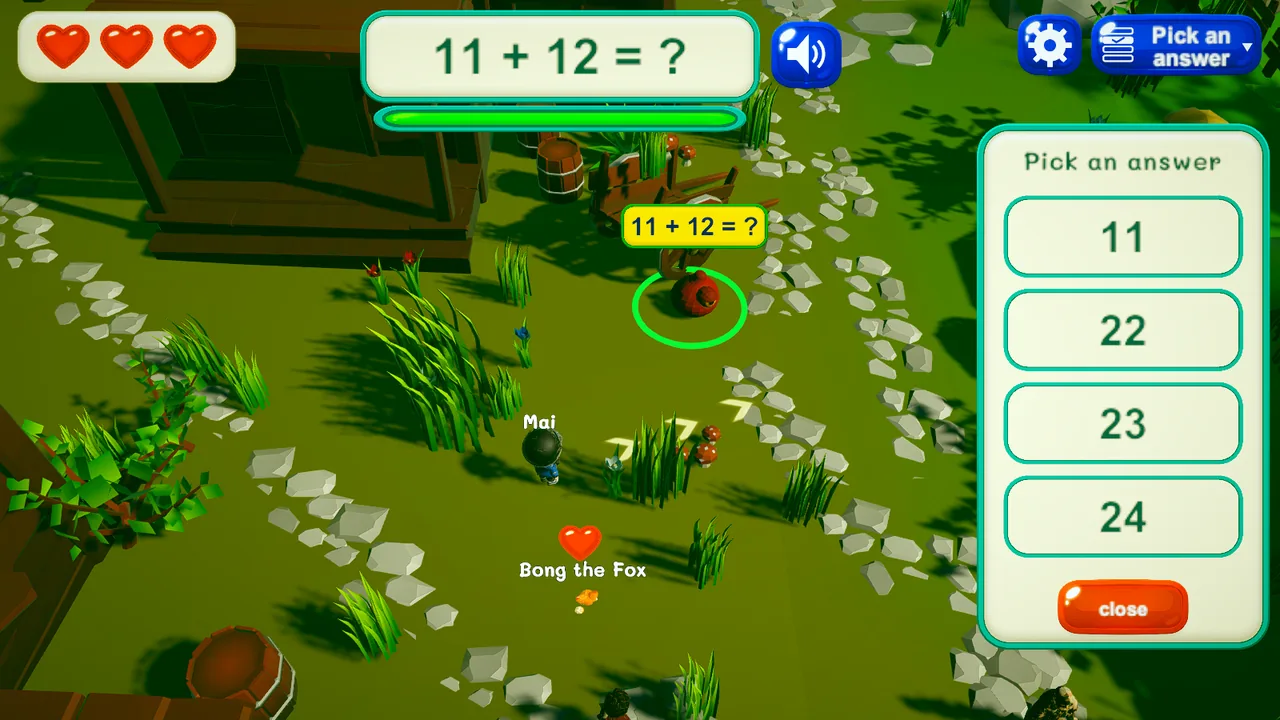
Pick an answer
Pick one of four answers. Good before writing feels easy. Because guessing can be lucky, a multiple-choice question counts as 400 points easier for math points.
Speak
Vietnamese only
Your child says the answer out loud in Vietnamese. The voice is recognized on the device and sent nowhere. Tap the microphone to talk, or let the game listen after reading the question. When the game says “I didn't quite hear you. Please say it again!”, it never counts as wrong. The first time it needs a voice download of about 75 MB.
Or pick one of four answers.
On a phone, the writing board stays roomy.
Lands
Five magic lands
Each land is a short story. From chapter 3, each chapter also carries a small lesson about getting along with others.
Chapter 1: Alpine Mountain Village
The village's Tree of Light is fading. With the Village Chief, Ms Le and Bim the goat, your child looks for the Light Gem beyond the rope bridge.
New friend:Bong the Fox
Chapter 2: Snow Land in the North
An ice golem's sneeze nearly puts out the big fire of Snowflake village. Your child gathers fire stones and lights it again.
New friend:Mit the Hedgehog
Chapter 3: A Letter on the Wind
A Japanese maple valley. A golem hugs the wind too tightly and makes the lanterns spin. With Auntie Yumi, Granny An, Uncle Ken and Little Momo, your child mends the wind lantern, then brings a little wind chime so the golem hears it and lets the wind go.
Lesson: listen and help a friend calm down.
New friend:Baby Dragon
Chapter 4: Where Did the Shadow Go?
A desert oasis. The monsters drag the sunshades away chasing the shade, and the playground gets hot. With Uncle Sami, Auntie Nila and Little Dau, your child puts the big sunshade back up, takes a midday rest, then lays out a cool rest mat so the spinning sand golem stops chasing its own shadow.
Lesson: be patient and rest at the right time.
New friend:Snow Dragon
Chapter 5: A Message on the Waves
A tropical island where toy boats carry messages to every house. A seashell golem hugs all the boats and doesn't dare ask whose they are. Your child asks Auntie San, Uncle Bo and Little Mi about the sail marks and brings each boat back to the right home.
Lesson: ask and accept help.
New friend:Bum the Otter
A thread through the story: from chapter 3, your child finds unsigned postcards, each with one word: “Listen”, “Wait”, “Ask”... Who sent them? The next chapter will tell.
Chapter 1 comes with the app. Chapters 2 to 5 download when your child gets there, and then play without internet.
Buddies
Pets, monsters and the star shop
Five pets
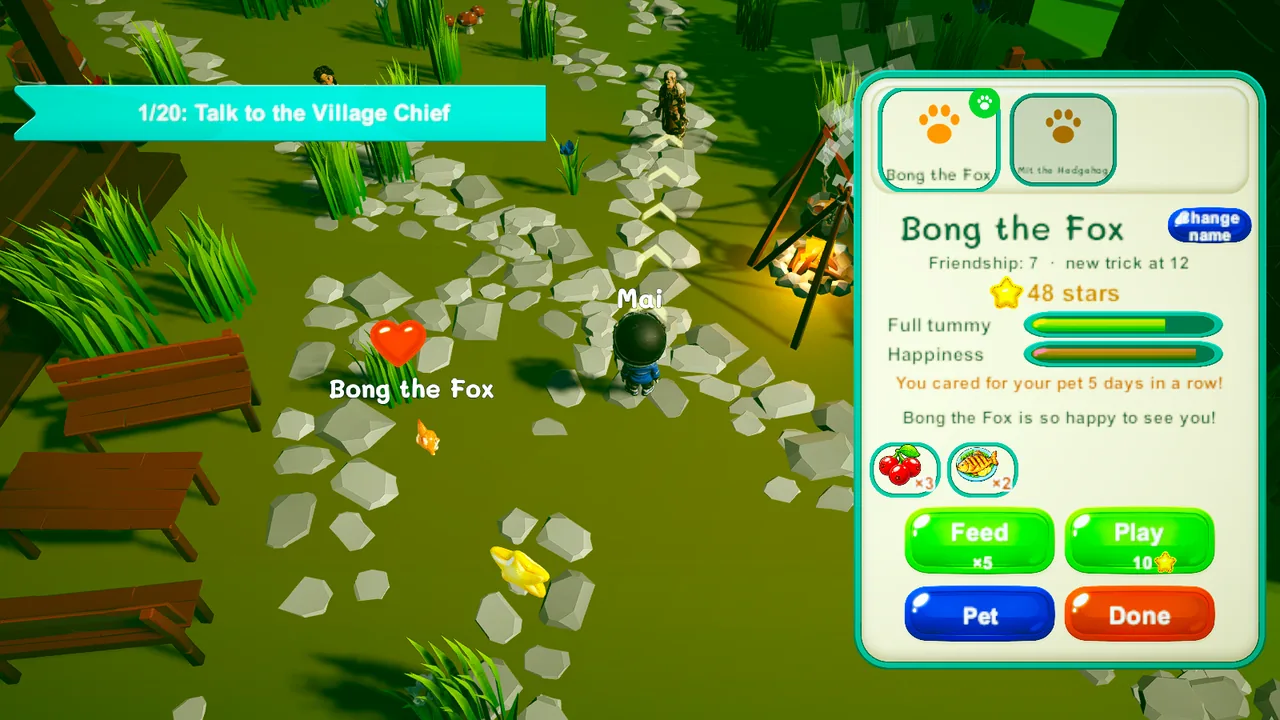
Bong the Fox, Mit the Hedgehog, Baby Dragon, Snow Dragon and Bum the Otter. Feed them, pet them and teach them tricks: “Jump”, “Do a roll” and “Sleep”; the dragons can also “Blow fire”. Care for a pet several days in a row and you become closer friends.
The monster notebook
A little mushroom, a chestnut hedgehog, a rock crab, a giant snowman, a tanuki, a small owl, a wind spirit, an ice seal, a sand golem, a coconut bubble and more. The monsters are not bad: your child uses math to ask them to make way, stop the mischief or calm down.
The star shop
Stars earned while playing buy new spells (bubble, fireball, ice, leaf, lightning, star fireworks), glows, outfits and pet treats (berries, grilled fish, honey, cake, star candy).
Stars can only be earned by playing. The game does not sell stars and has no paid random items.
Caring for Bong the Fox.
Math points
Math points: questions that grow with your child
Every kind of question has a difficulty rating. Your child has separate math points for Add, Subtract, Multiply and Divide, from 0 to 10,000; a new player starts at 1,000. Before each question, the game estimates the chance of a right answer and prefers questions your child gets right about 81.5% of the time, roughly 4 out of 5.
Default: the difficulty is “Leaf 0–100”. For questions that follow the math points as shown here, choose “Automatic” in the Parents' corner › Difficulty. At every level the math points are still updated after each answer.
1,000/ 10,000
Try it
Questions the game may ask at this level, and the chance of a right answer:
4 + 571%
2 + 190%
Press a button to see how the points change.
Add1,000
Subtract1,000
Multiply4,200opens at 3,600 math points
Divide4,500opens at 3,900 math points
Overall math points (average of the open operations): 1,000
The demo uses the game's own formula and numbers from the game code. It assumes your child is past the first 30 questions, answers in time, has no quick streak, and gets the first question of the list.
The 0 → 10,000 scale and a few sample questions
2 + 1400
4 + 51,100
12 + 51,900
11 + 122,600
8 + 73,300
5 × 74,200
7 × 85,300
23 × 46,200
34 × 278,000
875 ÷ 258,400
214 × 368,800
7,488 ÷ 249,400
Every 1,000 points is one star. The number on the right is the question's difficulty.
Three rules, in plain words
Right on the first try always gains
At least +1. The harder the question for your child, the bigger the gain.
Wrong costs a little
So the next question is easier. A miss right after 6 quick right answers in a row costs only half, since it may be a slip. Getting it right after a miss costs nothing more.
Slow is never punished
A slow answer only makes the gain smaller.
Four branches. Add and Subtract are open from the start. Multiply opens at 3,600 math points, Divide at 3,900; when they open, Multiply starts at 4,200 and Divide at 4,500, the level of their first questions. Overall math points are the average of the branches your child has practiced. The first 30 questions of each branch move faster to find your child's level.
Milestones. Each time your child passes another 1,000 points, the game cheers: “Great job! You got 3,000 math points!”
What does 10,000 mean? Right almost every time (about 97% or more in simulations), on the first try and in time, in all four operations, up to dividing a 4-digit number by a 2-digit number.
Points are not turned into school grades. Every child has their own pace.
Science
Built on research
Sugama did not invent a new way of scoring. Math points rest on ideas that have been studied for years.
1978
The Elo rating (chess)
Arpad Elo designed a way to rate chess players: beating a strong player gains a lot, beating a weaker one gains a little. Sugama treats each answer as a “game” between your child and the question.
Elo, 1978
2011
Math Garden (the Netherlands)
Researchers at the University of Amsterdam brought Elo to adaptive math practice for children: both the child and the question have a rating, updated after every answer, and questions are picked so the child gets about 75% right. In the paper, 3,648 children solved more than 3.5 million problems over 10 months. Sugama uses the same kind of formula and the same 75% at equal ratings.
Klinkenberg, Straatemeier and van der Maas, 2011
2013
More success, more practice
A 6-week experiment with 207 pupils in grades 3–6 on Math Garden set different success rates. The groups with a higher success rate attempted more problems and improved more. Math anxiety went down equally in all groups.
Jansen et al., 2013
2016
Elo in education
A review by Radek Pelánek concludes that Elo is simple, robust and effective for estimating student skill and question difficulty in adaptive learning systems.
Pelánek, 2016
ZPD
The zone of proximal development (Vygotsky)
Children learn well at tasks just beyond what they can do alone, with a person or a tool to help. In Sugama the help is the question read aloud, the hint “Count nice and slow!” and trying again without a penalty.
Vygotsky, 1978
2019
The “85% rule”
A theoretical study showed that for some kinds of learning, learning is fastest at about 85% right. It is a result on computer models, not a trial with children. Sugama prefers questions your child gets right about 81.5% of the time.
Wilson et al., 2019
+
Retrieval, quick feedback, spaced practice
Every sum is a moment of recall, and recalling helps memory more than re-reading. Your child knows right away whether the answer was right. Short practice spread over many days beats one long session. Sugama does not schedule reviews yet, so the last point is a tip for parents.
Roediger and Karpicke, 2006; Hattie and Timperley, 2007; Cepeda et al., 2006; Dunlosky et al., 2013
For parents who like formulas
Chance of a right answer:P = 1 / (1 + 10(Q − R − 572.5) / 1,200). R is your child's points for that operation, Q the question's difficulty. 572.5 = 1,200 × log₁₀3, so when Q = R, P = 75%. A question 1,200 points harder makes the odds 10 times smaller.
Picking: between R − 600 and R + 200, preferring around R − 200, where P ≈ 81.5%. The whole window spans P from about 90% down to 67%.
Right on the first try: gain speed × max(2, 60 × (1 − P)), at most +50. During the first 30 questions of a branch: factor 180, at most +120. A streak of 3 quick right answers multiplies the factor by 1.5, a streak of 6 by 3. Always at least +1.
Wrong: lose min(120 × P, 60); the first miss after 6 quick right answers counts 0.5 times.
Speed:1 if your child answers within 1.5 times the expected time (5 seconds + 1 second per 1,000 difficulty points), falling to 0.5 at 3 times that. Speed only makes a gain smaller; it never costs points.
Balance: at the aim point, a right answer gains about +11 and a wrong one loses about −60, so the points stand still at about 84% right. Simulations show children getting about 75–85% right throughout.
Multiple choice counts 400 points easier (guessing can be lucky). Boss fights ask questions 300 points harder.
What we do not claim
Sugama itself has not been tested in a controlled study. We promise no gains in test scores, IQ or any medical outcome. The research above shapes the design; it does not prove that Sugama works.
The difficulty of the 35 question types was set by us in the order of Vietnam's 2018 curriculum and tuned by simulation. Unlike Math Garden, these ratings do not learn from real answers.
The game only picks questions by math points when the difficulty is “Automatic”. The default is “Leaf 0–100”.
The 85% figure is a theoretical optimum; Sugama aims at about 81.5%.
Most studies on retrieval, spacing and handwriting were done with older pupils, adults or letters.
References
Ministry of Education and Training of Vietnam. (2018). General education curriculum: Mathematics [Chương trình giáo dục phổ thông môn Toán], issued with Circular 32/2018/TT-BGDĐT of 26 December 2018.
Cepeda, N. J., Pashler, H., Vul, E., Wixted, J. T., & Rohrer, D. (2006). Distributed practice in verbal recall tasks: A review and quantitative synthesis. Psychological Bulletin, 132(3), 354–380. doi:10.1037/0033-2909.132.3.354
Dunlosky, J., Rawson, K. A., Marsh, E. J., Nathan, M. J., & Willingham, D. T. (2013). Improving students’ learning with effective learning techniques: Promising directions from cognitive and educational psychology. Psychological Science in the Public Interest, 14(1), 4–58. doi:10.1177/1529100612453266
Elo, A. E. (1978). The rating of chessplayers, past and present. Arco.
Hattie, J., & Timperley, H. (2007). The power of feedback. Review of Educational Research, 77(1), 81–112. doi:10.3102/003465430298487
Jansen, B. R. J., Louwerse, J., Straatemeier, M., Van der Ven, S. H. G., Klinkenberg, S., & Van der Maas, H. L. J. (2013). The influence of experiencing success in math on math anxiety, perceived math competence, and math performance. Learning and Individual Differences, 24, 190–197. doi:10.1016/j.lindif.2012.12.014
Klinkenberg, S., Straatemeier, M., & van der Maas, H. L. J. (2011). Computer adaptive practice of Maths ability using a new item response model for on the fly ability and difficulty estimation. Computers & Education, 57(2), 1813–1824. doi:10.1016/j.compedu.2011.02.003
Longcamp, M., Zerbato-Poudou, M.-T., & Velay, J.-L. (2005). The influence of writing practice on letter recognition in preschool children: A comparison between handwriting and typing. Acta Psychologica, 119(1), 67–79. doi:10.1016/j.actpsy.2004.10.019
Pelánek, R. (2016). Applications of the Elo rating system in adaptive educational systems. Computers & Education, 98, 169–179. doi:10.1016/j.compedu.2016.03.017
Roediger, H. L., III, & Karpicke, J. D. (2006). Test-enhanced learning: Taking memory tests improves long-term retention. Psychological Science, 17(3), 249–255. doi:10.1111/j.1467-9280.2006.01693.x
Vygotsky, L. S. (1978). Mind in society: The development of higher psychological processes. Harvard University Press.
Wilson, R. C., Shenhav, A., Straccia, M., & Cohen, J. D. (2019). The Eighty Five Percent Rule for optimal learning. Nature Communications, 10, 4646. doi:10.1038/s41467-019-12552-4
For parents
The Parents' corner
Follow your child's progress and adjust the game in the Parents' corner.
Your child's report
Today; the last 7 days (days played, minutes, share right, share right on the first try, seconds per question); each operation; the chapters; a 14-day chart of math points. Reports are sent nowhere.
Difficulty
Seedling 0–10, Sprout 0–20, Leaf 0–100 (default) or Automatic, which follows your child's math points.
Your own questions
Tap “Download template”, edit it in Excel or Numbers, save it as CSV and pick the file. The game checks every row and explains errors in plain words.
And more
Replay a chapter · Gentle mode · read questions aloud · separate volumes for music, ambience, sound effects, the question voice and praise · show or hide math points while playing.
The parents' report: math points and the last 14 days.
Reports praise effort and progress, for example: “Mai is making great progress: +51 math points this week.” A slower week is never called a “drop”.
Our tips
A few short fights every day beat one long session. Research on spaced practice supports this.
Play together the first few times, especially while your child learns to write digits.
Praise effort and progress; do not compare your child's points with other children's.
Safety
Safety and privacy
No ads.
No stars or virtual money for sale; no paid random items.
No account: your child's progress is saved on the device.
The voice is recognized on the device and sent nowhere. “Save child's voice” is off by default; if a parent turns it on, recordings stay on the device and are deleted when it is turned off.
Handwriting is read on the device.
Reports are sent nowhere.
The app has no advertising, analytics or tracking tools.
Plays without internet once the chapters are downloaded.
Sugama is made for children aged 5 to 7. With “Automatic” chosen, older children still get questions at their level, up to dividing a 4-digit number by a 2-digit number.
Does it need the internet?
The first time, to download chapters, the handwriting reader and (if used) the voice data. After that it plays without internet.
Are there ads? Do you have to buy stars?
There are no ads. Stars are only earned by playing; the game does not sell stars and has no paid random items.
Are math points a school grade?
No. Math points show which questions suit your child right now; they do not place your child in a grade.
Does a slow answer lose points?
Never. A slow answer only makes the gain smaller.
What if my child gets many wrong?
Each miss lowers the points a little so the next question is easier, and the game gives a hint to try again. There is no game over: play just goes on.
Which devices?
iPad, iPhone and Android phones.
Is my child's voice sent anywhere?
No. It is recognized on the device. “Save child's voice” is off by default.
Can parents write their own questions?
Yes. In the Parents' corner, download the template, edit it in Excel or Numbers and pick it again.
Which languages?
Tiếng Việt, English and 日本語: menus, stories and voice. On first launch the game follows the device language; parents can change it in Settings. Spoken answers are Vietnamese only for now.
When does it launch?
Sugama is in internal testing. The launch date will be announced on this page.
Coming soon to the App Store and Google Play
Step with your child into a world where every right answer becomes a spell.